Repatha Benefits: 55–75% LDL Reduction, Proven Event Prevention, and Long-Term Cardiovascular Health
Repatha contributes to improved cardiovascular health by delivering one of the most powerful LDL-lowering effects available in clinical medicine. Patients and providers report achieving LDL-C levels previously unattainable on statin therapy alone — levels below 1.0 mmol/L (39 mg/dL) in many cases. By supporting dramatically lower circulating LDL, Repatha helps halt the progression of atherosclerosis — the buildup of plaque in arterial walls that causes heart attacks and strokes — and in some patients drives measurable plaque regression.
The FOURIER cardiovascular outcomes trial enrolled over 27,000 patients with established atherosclerotic cardiovascular disease on background statin therapy. Evolocumab reduced LDL-C by approximately 59% and cut the risk of the composite primary endpoint by 15%, with a 27% reduction in heart attack risk and a 21% reduction in stroke risk. These are not marginal improvements — they represent a meaningful reduction in the risk of life-altering events for patients already on the best available background therapy.
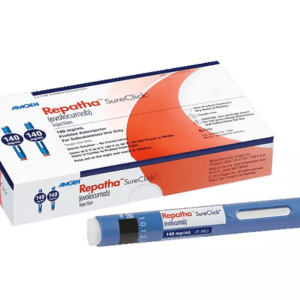
Repatha is available through Elivena as Repatha 140 mg/mL in a single-use pre-filled autoinjector. The extended FOURIER-OLE follow-up confirmed that cardiovascular benefits deepen over time with no new safety signals, reinforcing Repatha’s role as a long-term cardiovascular risk reduction tool.
Taking Repatha: Dosage Guidance for Effective Cholesterol Management and Cardiovascular Risk Reduction
Before starting Repatha, it is important to consult with a cardiologist or lipid specialist who can evaluate your LDL-C targets and determine the appropriate regimen. Repatha is administered by subcutaneous injection — either 140 mg every two weeks or 420 mg once monthly using three consecutive injections within 30 minutes. Following the prescribed schedule consistently is essential to maintaining the level of PCSK9 inhibition needed for sustained LDL-C control.
Allow the autoinjector to reach room temperature for at least 30 minutes before each injection. Rotate injection sites between the abdomen, upper arm, and thigh. Repatha must be stored at 2°C–8°C and must never be frozen. It may be kept at room temperature up to 25°C for a single period of up to 30 days — a practical feature for patients who travel. Your healthcare provider will monitor LDL-C periodically and adjust your regimen as needed. A prescription is required.
Repatha Supports Long-Term Cardiovascular Health and a Better Quality of Life
By incorporating Repatha into your cardiovascular management plan, you are making a proactive commitment to protecting your heart and arteries for the long term. With its focus on sustained LDL-C reduction and proven event prevention, Repatha supports the kind of cardiovascular resilience that allows people to stay active, energetic, and confident in their long-term health. Order Repatha through Elivena’s secure platform and access verified, cold-chain compliant product from a Canadian-licensed supply chain.
Elivena manages cold-chain logistics end-to-end for all Repatha orders. Our cardiovascular account team supports healthcare providers and distributors with supply planning, documentation, and bulk arrangements. Browse the full Cardiovascular category at Elivena to explore the complete range of heart health products available.
How Repatha Controls Cholesterol Through PCSK9 Inhibition
The active ingredient in Repatha is evolocumab — a fully human monoclonal antibody of the IgG2 subclass produced using recombinant DNA technology. Evolocumab works by binding with high affinity to PCSK9, a protein produced by the liver that normally targets LDL receptors for degradation after they have captured and removed LDL particles from the blood.
By neutralising PCSK9, evolocumab allows LDL receptors to recycle efficiently to the hepatocyte surface rather than being destroyed. More receptors on the liver surface means dramatically more LDL clearance from the circulation — a 55 to 75% reduction in LDL-C on top of statin therapy. The mechanism is independent of statins, which is why Repatha adds meaningful LDL reduction regardless of what background therapy a patient is already on. The IgG2 subclass is selected for low immunogenicity, reducing the risk of immune reactions with long-term use.
Repatha and Cardiovascular Science: A Proven Approach to Reducing Atherosclerotic Disease
Recent evidence has solidified Repatha’s position as a cornerstone of advanced cardiovascular risk management. The GLAGOV trial demonstrated that evolocumab on top of statin therapy produced significant regression of coronary artery plaque volume — one of the first direct demonstrations that LDL-C reduction at this scale can physically reverse the progression of atherosclerosis rather than merely slow it.
The FOURIER-OLE open-label extension study, following patients for up to five years of evolocumab treatment, showed that the cardiovascular benefit of Repatha continues to grow with longer treatment duration — suggesting that the value of sustained LDL-C lowering compounds over time. These findings underscore the importance of treating to very low LDL targets and maintaining that reduction with a reliable, consistently dosed therapy.
Repatha and Familial Hypercholesterolemia: Expanding Cardiovascular Protection Beyond Statin Therapy
While Repatha’s cardiovascular outcomes data centres on patients with established ASCVD, its benefits are equally critical for patients with familial hypercholesterolemia — a genetic condition that causes very high LDL cholesterol from birth regardless of diet or lifestyle. Heterozygous FH affects approximately 1 in 300 people worldwide; homozygous FH is rarer and more severe, often producing LDL levels several times the normal range even in childhood. For these patients, reaching guideline-recommended LDL targets without PCSK9 inhibition is often impossible. Repatha provides the degree of reduction that guideline-recommended targets demand, offering meaningful cardiovascular protection to a population for whom standard options fall short.

 130
130