Longevity & Anti-Aging Peptide Compounds: Research Catalog
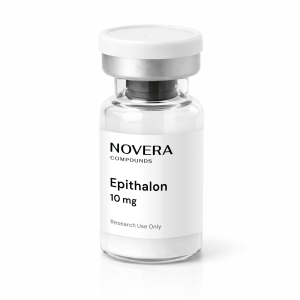
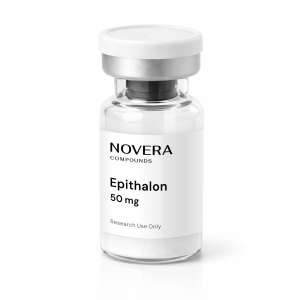
Epitalon — 50 mg
| Sequence |
Tetrapeptide: Ala-Glu-Asp-Gly (4 AA) |
| Molecular Weight |
390.35 Da |
| Format |
Lyophilized powder, 50 mg unit |
| Purity |
≥98% (HPLC verified, COA on file) |
| Research Classification |
Pineal bioregulator peptide; studied in telomerase reverse transcriptase (TERT) expression assays, telomere length regulation models, and circadian-endocrine gene expression research in aging cell line systems |
GHK-Cu (Copper Peptide) — 50 mg
| Sequence |
Tripeptide-copper complex: Gly-His-Lys · Cu²⁺ |
| Molecular Weight |
340.38 Da (free peptide); 403.95 Da (copper complex) |
| Format |
Lyophilized powder, 50 mg unit |
| Purity |
≥98% (HPLC verified, COA on file) |
| Research Classification |
Copper-binding tripeptide; studied in fibroblast collagen synthesis pathway assays, extracellular matrix remodeling models, and superoxide dismutase (SOD) activity research in aging cell biology in vitro |
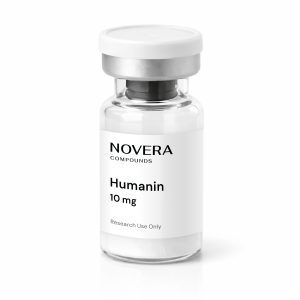
Humanin — 1 mg
| Sequence |
21-residue mitochondria-derived peptide: Met-Ala-Pro-Arg-Gly-Phe-Ser-Cys-Leu-Leu-Leu-Leu-Thr-Ser-Glu-Ile-Asp-Leu-Pro-Val-Lys |
| Molecular Weight |
2,187.72 Da |
| Format |
Lyophilized powder, 1 mg vial |
| Purity |
≥98% (HPLC verified, COA on file) |
| Research Classification |
Mitochondria-derived peptide (MDP); studied in STAT3 and FPRL1 receptor interaction models, mitochondrial apoptosis pathway assays, and neuroprotective signaling cascade research in cellular aging models |
SS-31 (Elamipretide) — 5 mg
| Sequence |
Tetrapeptide: D-Arg-Dmt-Lys-Phe-NH2 (aromatic-cationic mitochondria-targeting peptide) |
| Molecular Weight |
638.82 Da |
| Format |
Lyophilized powder, 5 mg vial |
| Purity |
≥98% (HPLC verified, COA on file) |
| Research Classification |
Mitochondria-targeted peptide; studied in cardiolipin interaction assays, mitochondrial membrane potential models, reactive oxygen species (ROS) quantification, and ATP synthesis pathway research in cellular aging and bioenergetics studies |
Research Applications: Four Areas of Laboratory Investigation
- Telomere Biology and Cellular Senescence Models
Peptide compounds classified within longevity-associated research have appeared in laboratory investigations focused on telomere regulation and cellular senescence signaling architecture.
Epitalon, for example, has been described in published literature examining telomerase reverse transcriptase (TERT) expression dynamics in aging-derived cell line systems. In vitro assays in this domain include:
- Telomere length quantification via quantitative PCR (qPCR)
- Terminal restriction fragment (TRF) analysis via Southern blot
- Senescence-associated beta-galactosidase staining
- p21 and p16 pathway expression profiling
All measurements are conducted in controlled cell culture environments and interpreted as molecular pathway data within defined experimental systems.
- Mitochondrial Membrane Dynamics and Bioenergetics Research
Mitochondria-targeted peptides such as SS-31 and Humanin have been documented in preclinical and in vitro research examining mitochondrial membrane interaction and bioenergetic signaling models.
SS-31 has been characterized in cardiolipin-binding assays and electron transport chain complex activity studies. Experimental endpoints commonly include:
- Mitochondrial membrane potential measurement (JC-1, TMRE assays)
- ATP quantification assays
- Oxygen consumption rate (OCR) analysis via Seahorse platforms
- ROS quantification in metabolically stressed cell models
These assays describe mitochondrial signaling and bioenergetic dynamics in cultured cells and do not constitute organism-level performance or longevity claims.
- Oxidative Stress Pathway and ROS Marker Quantification
Reactive oxygen species research represents a core domain in which longevity-associated peptides appear in published cell biology literature.
GHK-Cu has been examined in fibroblast and epithelial cell line systems to evaluate:
- Superoxide dismutase (SOD) activity
- Catalase activity
- Nrf2-associated signaling
- ROS quantification via DCFH-DA fluorescence
SS-31 has been investigated in mitochondrial stress models using fluorescent ROS probes and membrane potential assays to characterize intracellular oxidative signaling dynamics.
All endpoints reflect biochemical pathway activity under defined in vitro conditions.
- Extracellular Matrix Remodeling and Collagen Pathway Research
GHK-Cu is among the peptides frequently documented in research examining collagen-associated gene expression and extracellular matrix signaling in vitro.
Studies have evaluated:
- Procollagen type I and III expression markers
- TGF-β receptor–associated Smad signaling
- Matrix metalloproteinase (MMP) activity profiling
- ECM turnover marker quantification
These investigations fall within connective tissue cell biology and biochemical signaling research. All assays described are conducted in vitro and do not represent dermal, connective tissue, or systemic outcomes in vivo.
Selecting the Right Compound for Your Research Protocol
Researchers designing studies in cellular aging, senescence biology, mitochondrial pathway investigation, or oxidative stress research typically evaluate compounds based on:
- Documented receptor interaction and molecular target profiles
- Published pathway signaling data
- Subcellular localization properties relevant to the experimental model
- Stability under assay temperature and pH conditions
- COA-confirmed purity and endotoxin specifications for cell-based systems
Novera provides complete product specifications for each compound, including molecular weight, sequence identity, storage requirements, solubility data, and available presentation formats.
Novera does not provide experimental design guidance, dosing parameters, or interpretation of research outcomes.
Institutional procurement offices and principal investigators with multi-compound or volume supply requirements may contact Novera’s research supply team to confirm batch availability, lot-to-lot consistency documentation, and GMP certification status.
Supply and Quality Standards
All compounds in this category are manufactured in USA-based GMP-certified facilities. Standard quality documentation includes:
- Certificate of Analysis (COA) confirming molecular identity and HPLC-verified purity
• Mass spectrometry sequence confirmation for synthesized peptides
• Endotoxin testing (LAL method) available upon request
• Sterility certification for applicable lyophilized or solution formats
• Temperature-controlled cold-chain shipping for stability-sensitive materials
• Compliance with USA regulatory frameworks governing research compound distribution
Novera does not supply compounds for human or veterinary administration. All materials are classified strictly as research-use-only biochemical reagents.
Longevity & Anti-Aging Peptides: Research Classification and Molecular Context
In scientific literature, “longevity peptides” and “anti-aging peptides” function as categorical descriptors applied to amino acid sequences studied for their molecular interactions with pathways associated with cellular aging processes.
These pathways include:
- Telomere maintenance mechanisms
- Mitochondrial membrane signaling
- Oxidative stress response cascades
- Extracellular matrix turnover signaling
Compounds catalogued in this category are classified according to documented molecular targets and the research domains in which they appear in peer-reviewed literature. Classification is based exclusively on mechanistic research profiles.
No compound in this catalog is represented as influencing lifespan, reversing aging, or functioning as a therapeutic or wellness intervention.
All materials are supplied strictly as experimental molecular tools for qualified laboratory investigation.

 132
132