Your cart is empty.
Your cart is empty.


99.2% On-Time Delivery
Tracked International Shipping
Refund Within 28 Days
Secure, Encrypted Checkout
Each peptide batch is tested and verified to meet or exceed 98–99% purity (HPLC).
Store 2–8 °C (≤–20 °C long-term). RT exposure during transport acceptable. Protect from light.
99.2% On-Time Delivery
Tracked International Shipping
Refund Within 28 Days
Secure, Encrypted Checkout
$162.00
This product is available by prescription only
This product does not require a prescription
Out Of Stock
Each peptide batch is tested and verified to meet or exceed 98–99% purity (HPLC).
Store 2–8 °C (≤–20 °C long-term). RT exposure during transport acceptable. Protect from light.
The product is delivered in powdered (lyophilized) form and must be properly reconstituted prior to research use.
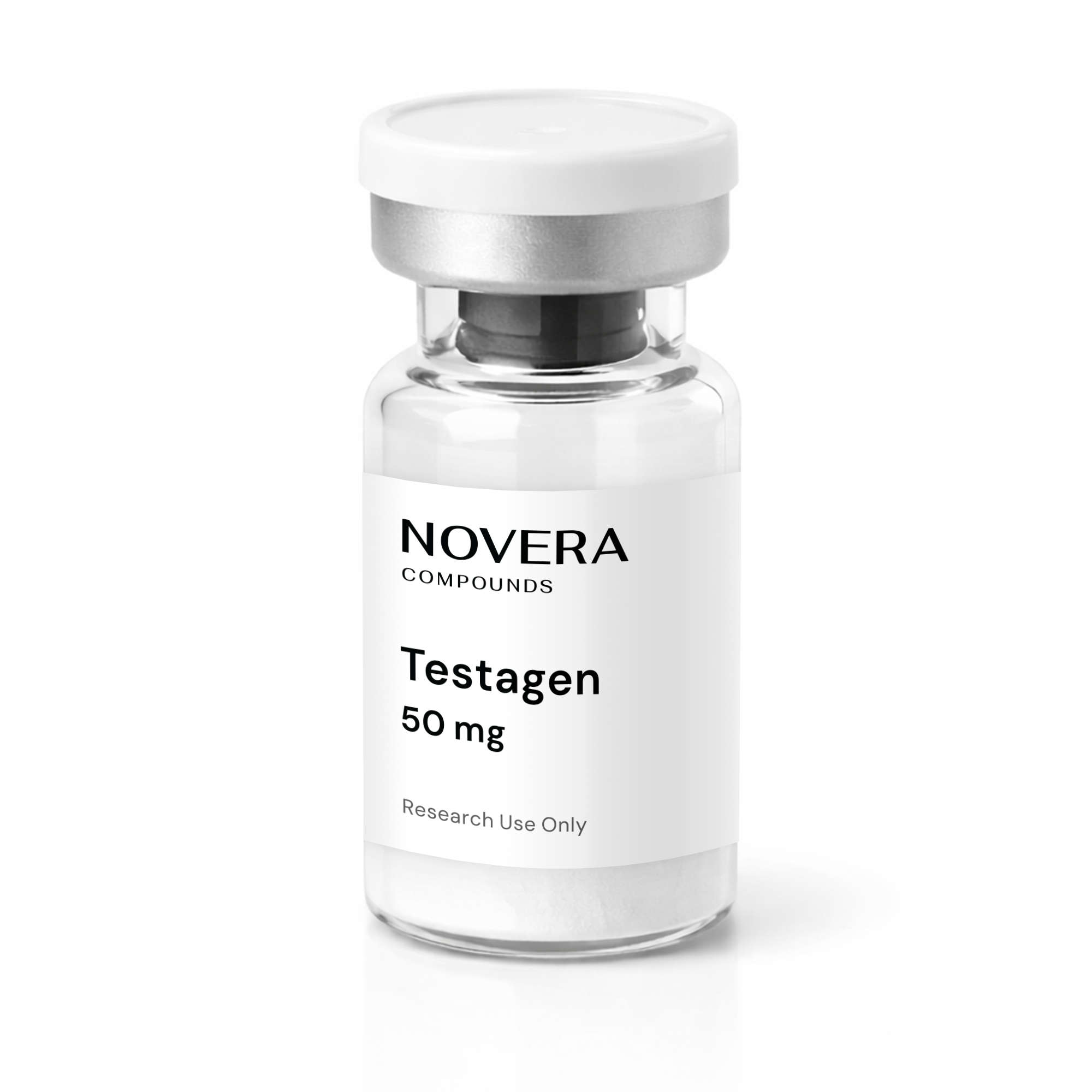
Testagen peptide is produced through synthetic laboratory processes. Synthetic production means the compound is assembled from defined amino acid sequences under controlled conditions.
The 50mg pack size supports larger experimental frameworks. Larger quantity formats assist laboratories managing multiple analytical phases within one research cycle.
Each batch is verified for peptide purity before release. Peptide purity refers to the measured percentage of the intended molecular structure. High purity supports consistent research outcomes.
All shipments are sealed and prepared for professional laboratories in the United States and international facilities. Packaging is protective and discreet to maintain structural stability during transit.
Researchers investigate peptide signaling and regulatory interaction research models. Peptide signaling refers to molecular communication between cells. Regulatory interaction describes how one molecule influences another within a controlled system.
Experimental peptide communication models are also examined. Communication models simulate how molecules exchange signals inside laboratory environments. These models help researchers measure structural and temporal patterns.
Controlled laboratory peptide stability studies are conducted. Stability refers to how well the molecular structure remains intact over time. Environmental variables such as temperature and light exposure are evaluated.
The testagen peptide is analyzed within peptide research frameworks focused on structural sequencing and interaction mapping. Interaction mapping means documenting how molecules connect within a defined system.
Testagen is investigated in research environments studying molecular structure consistency. Structural consistency refers to uniform amino acid arrangement across batches.
It is studied within controlled laboratory models designed to observe regulatory communication sequences. Communication sequences describe the order in which molecular signals occur.
The compound is explored for experimental peptide research related to interaction timing. Interaction timing refers to how quickly molecules bind and release within a measured setting.
Researchers also examine stability across buffered laboratory systems. Buffered systems maintain constant chemical balance. This allows consistent comparison between experimental units.
All studies are performed strictly within research settings. No clinical or therapeutic positioning is implied.
Store in cool, dry, and light-protected conditions. Refrigeration supports long-term molecular integrity.
Laboratory handling only. This compound must be managed by qualified research personnel.
Avoid exposure to moisture and excessive heat. Environmental stress may influence structural stability.
Maintain sealed containment until analysis begins. Use calibrated laboratory tools for measurement of each research unit. Structured documentation supports traceability from start to finish.
Purity verification procedures are completed for every batch. High-performance liquid chromatography is commonly used. This method separates compounds to evaluate peptide purity.
Mass analysis may also be conducted. Mass analysis confirms molecular weight accuracy.
Batch-to-batch consistency is recorded under internal quality assurance standards. These standards guide production, filtration, and packaging protocols.
Quality control testing testagen peptide procedures include impurity screening and identity confirmation. Analytical documentation supports research peptide supply reliability.
The material is positioned strictly within the research-grade supply category. It is not associated with prescription distribution or order pharmacy channels. No doctor authorization is required because it is not intended for health systems, patient care, treatment development, or blood sugar regulation studies involving clinical models.
It is not positioned for body-level therapeutic investigation, pain analysis in patients, or sugar metabolism research tied to medical prescription frameworks. It does not replace a prescription, doctor supervision, or treatment protocol.
Taking testagen peptide outside controlled research settings is not supported. Research institutions start procurement through authorized laboratory supply processes.
Testagen is a synthetic peptide. It is composed of a defined chain of amino acids assembled under laboratory conditions. Amino acids are the structural components that form peptide chains.
Regulatory peptide interaction refers to how peptides influence molecular processes inside a controlled model. This influence occurs when one molecule interacts with another and modifies a measurable signal.
Signaling-regulating peptides are studied because they provide insight into molecular communication systems. Molecular communication describes how signals move between components within a test environment.
The testagen peptide is manufactured according to defined molecular specifications. Identity confirmation is performed using analytical measurement techniques. These techniques measure molecular weight and structural alignment to verify accuracy.
Novera Research delivers high-quality research peptides developed under strict manufacturing and quality-control standards. Each product is carefully synthesized, tested, and handled to ensure consistency, reliability, and transparency for advanced research applications.
High-purity, research-grade peptide synthesis
Analytical testing to verify quality and composition
Consistent batch-to-batch performance
Batch identification on every vial for traceability
Stored and shipped under controlled conditions
A synthetic GHRH analog studied for receptor binding kinetics, molecular interaction modeling, and pulsatile signaling pathway investigation in preclinical settings.
Research-grade synthetic peptide fragment formulated for advanced laboratory peptide research and experimental scientific protocols. Disclosure: This product is intended for research purposes only and is not intended for human consumption...
A high-concentration, long-acting GLP-1 receptor agonist studied for incretin pathway receptor pharmacology, downstream cAMP signaling cascade dynamics, and multi-arm metabolic endpoint marker quantification in extended institutional research protocols.
Research-grade synthetic peptide inhibitor designed for experimental peptide-protein interaction research in controlled laboratory settings.
A synthetic aromatic-cationic tetrapeptide studied for selective inner mitochondrial membrane localization, cardiolipin binding dynamics, and oxidative phosphorylation pathway marker activity in controlled in-vitro and preclinical models.
This website contains information on research compounds intended for laboratory use only. You must be 21 years or older to enter and view this content. By entering, you also agree that all products are for research use only and are not intended for human consumption.
We'll send the lab results to this email address.