Licensed partner pharmacies

99.2% On-Time Delivery

Tracked international shipping

Tracked International Shipping

Refund within 28 days

Refund Within 28 Days

Secure, encrypted checkout

Secure, Encrypted Checkout

99% Purity guarantee

Each peptide batch is tested and verified to meet or exceed 98–99% purity (HPLC).

Storage Handling Notice

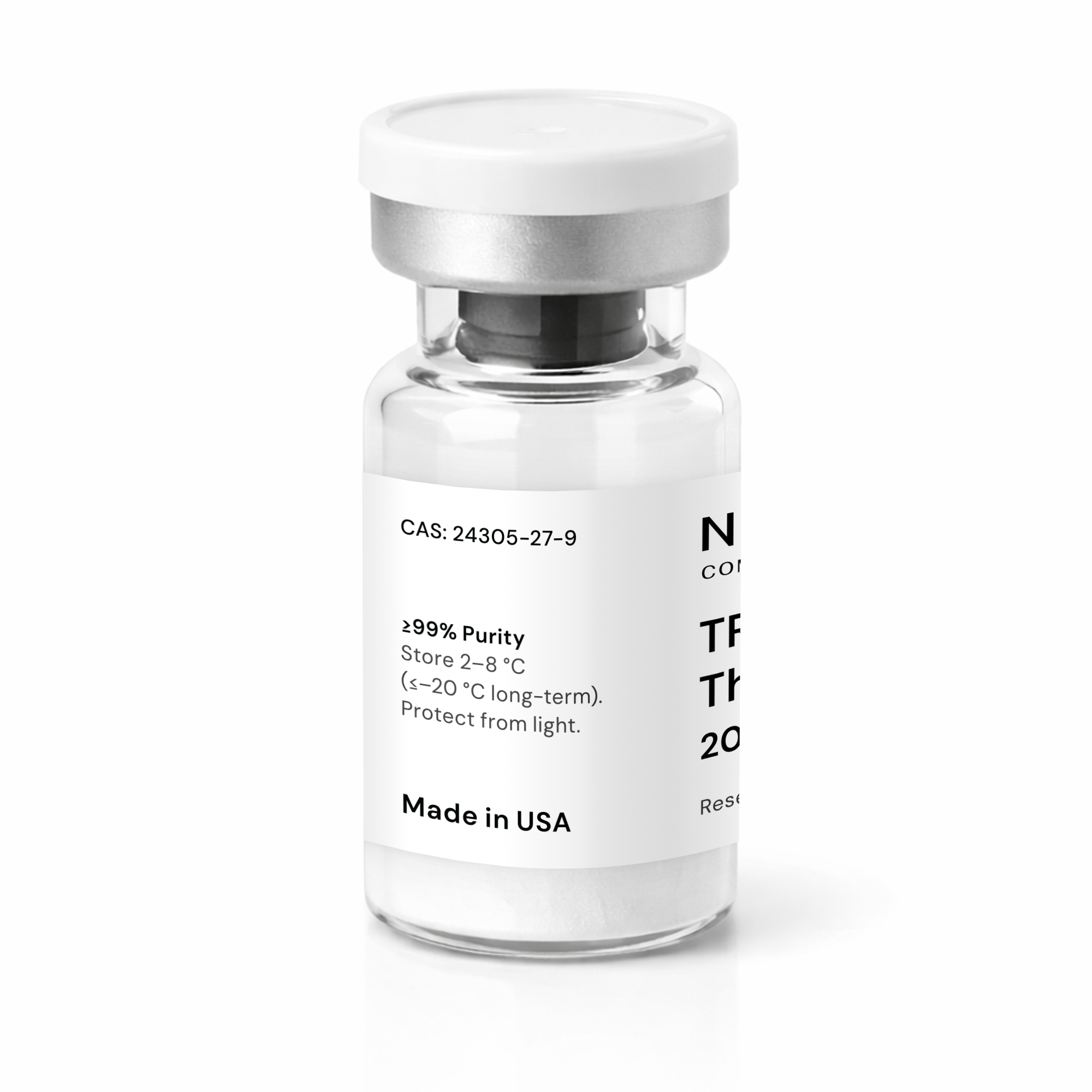
Store 2–8 °C (≤–20 °C long-term). RT exposure during transport acceptable. Protect from light.

Licensed partner pharmacies

99.2% On-Time Delivery

Tracked international shipping

Tracked International Shipping

Refund within 28 days

Refund Within 28 Days

Secure, encrypted checkout

Secure, Encrypted Checkout

TRH Thyrotropin (20mg)

$98.00

Coming Soon!

This product is available by prescription only

This product does not require a prescription

Out Of Stock

99% Purity guarantee

Each peptide batch is tested and verified to meet or exceed 98–99% purity (HPLC).

Storage Handling Notice

Store 2–8 °C (≤–20 °C long-term). RT exposure during transport acceptable. Protect from light.

Product Form

The product is delivered in powdered (lyophilized) form and must be properly reconstituted prior to research use.

1. Defined Tripeptide Structure

TRH consists of three amino acids: pyroglutamic acid (pyroGlu), histidine (His), and proline amide (ProNH₂). The N-terminal pyroglutamate modification contributes to increased resistance to enzymatic degradation, making TRH particularly useful in stability and metabolism studies.

Researchers frequently analyze:

  • Peptide conformational stability
  • Enzymatic cleavage resistance
  • Receptor binding domains
  • Structural modification impact on biological activity

Its well-characterized molecular structure allows reproducible laboratory investigation.

2. Neuroendocrine Signaling Research Model

TRH is widely utilized in controlled laboratory models examining hypothalamic–pituitary communication mechanisms. It enables investigation of:

  • Second messenger systems
  • Phospholipase C activation pathways
  • Intracellular calcium signaling
  • Transcriptional regulation associated with endocrine peptides
  • Feedback loop modeling within axis-based systems

Because it operates at an upstream regulatory level, TRH is often studied to understand hierarchical endocrine control mechanisms under controlled experimental conditions.

3. Analytical and Molecular Research Applications

TRH 20mg is suitable for:

  • Chromatographic method development (HPLC, LC-MS validation)
  • Peptide quantification assays
  • Receptor affinity studies
  • Molecular docking simulations
  • Stability testing under varied temperature and light exposure
  • Comparative peptide analog research

Its compact size and defined sequence make it a useful benchmark compound in peptide research laboratories.

TRH 20mg is supplied exclusively for research purposes.
It is not intended for human consumption, veterinary use, diagnostic procedures, therapeutic application, or bodily introduction into humans or animals.

This compound is not approved by the FDA, EMA, or any regulatory authority for medical use. It is furnished solely to qualified researchers and institutions for laboratory investigation.

Scientific Background

Thyrotropin-Releasing Hormone (TRH) is a naturally occurring tripeptide synthesized in the hypothalamus. It plays a central role in the regulation of the hypothalamic–pituitary–thyroid axis. In physiological systems, TRH interacts with specific receptors on pituitary thyrotroph cells, initiating intracellular signaling pathways that regulate endocrine communication.

In research settings, TRH is studied for:

  • Peptide-receptor interaction modeling
  • G-protein–coupled receptor (GPCR) signaling pathways
  • Endocrine axis feedback regulation
  • Neuroendocrine signal transduction
  • Molecular stability and peptide degradation kinetics
  • Structure–activity relationship (SAR) investigations

Due to its relatively simple tripeptide structure, TRH also serves as a useful model compound for peptide synthesis validation and analytical method development.

TRH is typically examined within structured laboratory frameworks such as:

  • Cellular receptor activation assays
  • Signal amplification studies
  • Endocrine axis modeling systems
  • Gene expression response experiments
  • Peptide stability time-course analysis

Experimental timelines vary depending on the nature of the investigation, including short-term receptor-binding kinetics or extended molecular stability assessments.

All research should be conducted in compliance with institutional laboratory standards and regulatory guidelines governing experimental compounds.

Institutional Research Perspective

Laboratories engaged in endocrine research, molecular pharmacology, peptide chemistry, and neuroendocrine signaling studies utilize TRH as a foundational model peptide.

Institutional research teams value TRH for:

  • Its clearly defined biological role
  • Its reproducible receptor-mediated signaling profile
  • Its suitability for mechanistic investigation
  • Its relevance in endocrine communication modeling

When used within properly controlled laboratory systems, TRH supports structured investigation of peptide-mediated signaling pathways without extrapolation beyond research parameters.

Storage Conditions

  • Store lyophilized powder at 2–8°C
  • Protect from light and moisture
  • Maintain sealed container integrity until use

Under appropriate storage conditions, peptide stability is preserved for extended laboratory use.

Reconstitution (Laboratory Use Only)

For analytical preparation:

  • Reconstitute using sterile laboratory-grade solvent under controlled conditions
  • Use aseptic laboratory technique
  • Prepare small aliquots when conducting extended analytical studies to reduce repeated freeze-thaw exposure

After reconstitution:

  • Store refrigerated
  • Avoid repeated temperature fluctuations
  • Follow institutional laboratory handling protocols

This product does not require cold-chain shipping but must be refrigerated upon receipt.

TRH 20mg is synthesized in GMP-certified facilities under strict quality control conditions. Each batch undergoes:

  • Purity verification (target ~99%)
  • Sequence confirmation
  • Mass spectrometry validation
  • Analytical chromatography testing
  • Certificate of Analysis (COA) documentation

All materials are produced according to pharmaceutical-grade research standards to ensure consistency, reproducibility, and laboratory reliability.

  • CAS: 24305-27-9
  • Chemical Formula: C₁₆H₂₂N₆O₄
  • Molecular Weight: 362.38 g/mol
  • Peptide Sequence: Pyr-His-Pro-NH2
  • Synonyms: Protirelin
  • Shelf life: 24 months from the manufacturing date.

Why Choose Novera Research Peptides?

Novera Research delivers high-quality research peptides developed under strict manufacturing and quality-control standards. Each product is carefully synthesized, tested, and handled to ensure consistency, reliability, and transparency for advanced research applications.

High-purity, research-grade peptide synthesis

Analytical testing to verify quality and composition

Consistent batch-to-batch performance

Batch identification on every vial for traceability

Stored and shipped under controlled conditions

Frequently bought together

Order TRH Thyrotropin (20mg)
Reliable Research-Grade TRH Thyrotropin (20mg) Peptide with Verified Laboratory Quality
When purchasing TRH 20mg for research purposes, qualified institutions receive:
  • Pharmaceutical-grade synthetic peptide
  • Verified Certificate of Analysis
  • Purity and identity documentation
  • Secure packaging for laboratory transport
This compound is supplied exclusively to support structured scientific investigation in endocrine and peptide research fields.

Frequently Asked Questions

What makes TRH useful in laboratory research?
Is TRH suitable for analytical method development?
Can TRH be used outside laboratory research?